Free mortgage tools · no signup · no sales calls "Not a lender." For the people, est. 2026
Calculate My Ratemortgage math, made clear Run my numbers

Your rate,

The free interactive mortgage rate calculator. See your rate, your payment and exactly why, before you ever talk to a lender.

Mortgage calculator

Plug in your rate.

Type the rate a lender quoted you, or drag the dial. See your payment, and what every eighth of a point is worth.

$
%
Term
%
Type it, or drag the dial · arrow keys move ⅛ point
Monthly principal & interest
Every ⅛ point
Loan amount
Total interest
Half a point lower
Educational estimate · principal & interest onlyAdd taxes, insurance & PMI
The problem → our solution

Same loan. Different risk factors.

The same $200,000 loan, priced for two buyers. Follow each row from credit score to monthly payment.

Free homebuyer toolkit

Five printables. Zero cost.

Five worksheets that take you from your first credit check to your first year in the home. Download, print, and fill them in by hand. No signup, no email.

One 10-page PDF · letter size · prints in black & white
Home Buying Budget coverHome Buying Journal coverKnow Your Numbers coverFirst-Year Checklist coverHome Comparison Sheet cover
  1. 01
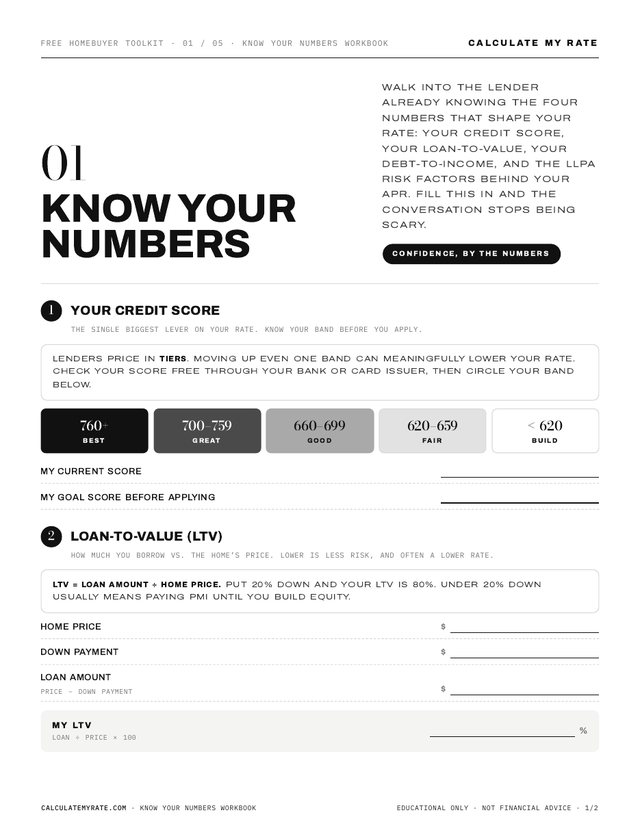
    Know Your NumbersCredit score, LTV, DTI and the LLPA factors behind your rate.
    2 pages · PDFDownload
  2. 02
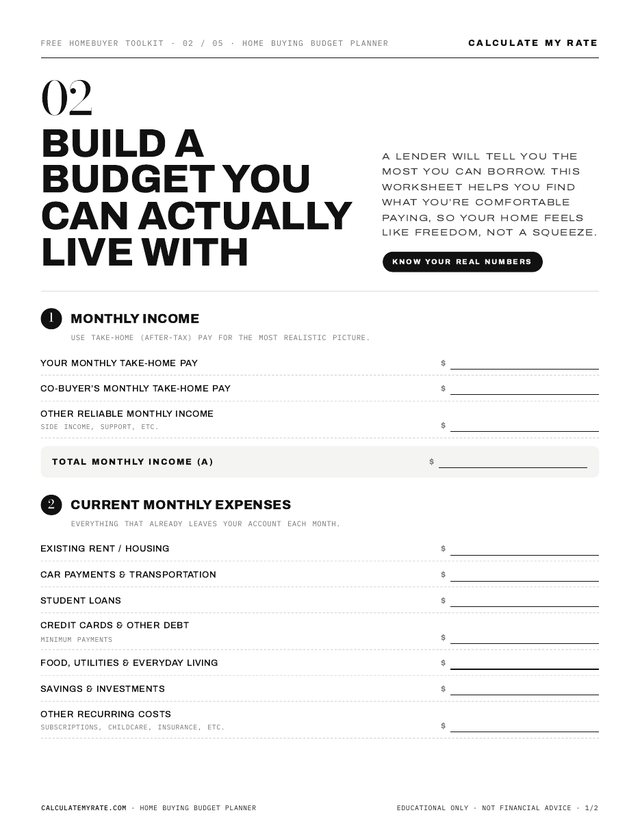
    Home Buying BudgetFind the payment you’re comfortable with, not just the most you can borrow.
    2 pages · PDFDownload
  3. 03
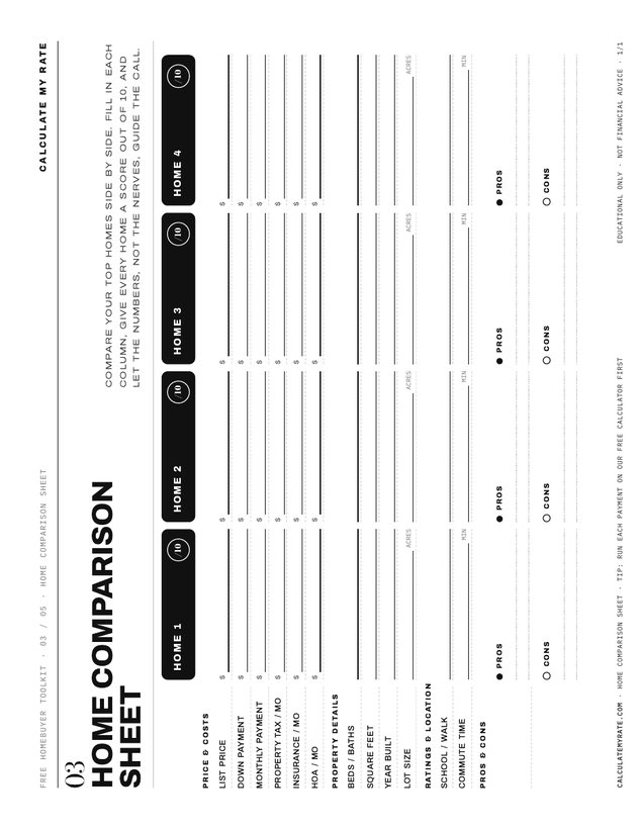
    Home Comparison SheetScore up to four homes side by side on cost, details and location.
    1 page · PDFDownload
  4. 04
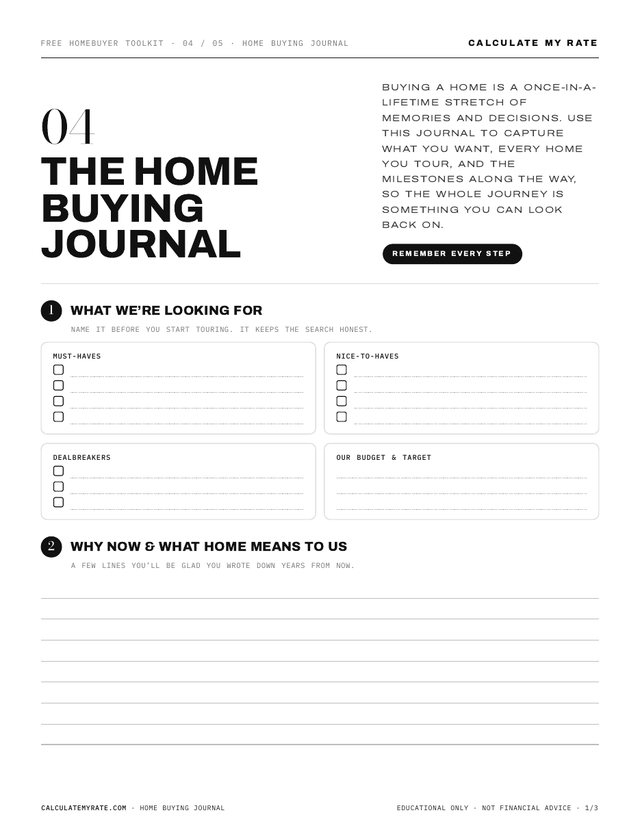
    Home Buying JournalWhat you want, every showing, and the milestones to the keys.
    3 pages · PDFDownload
  5. 05
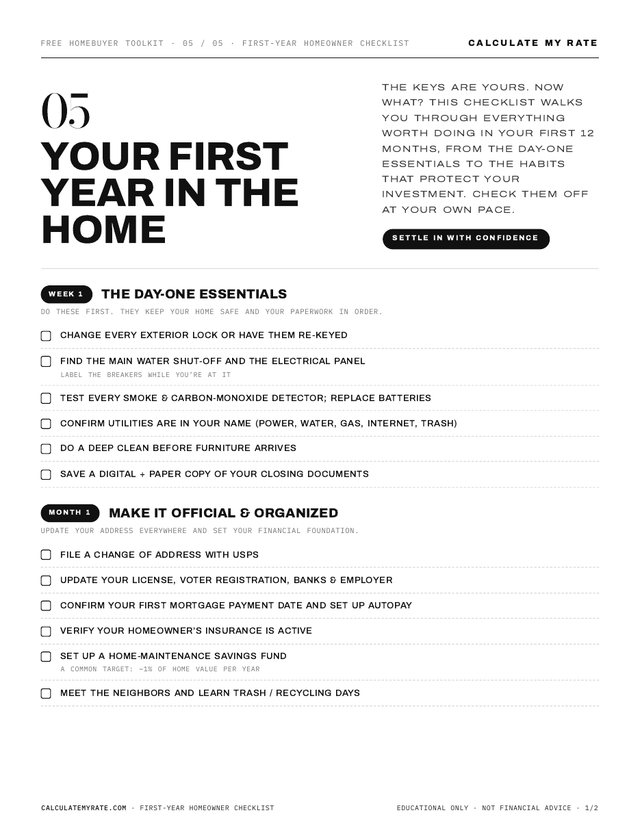
    First-Year ChecklistWeek one through month twelve in your new home.
    2 pages · PDFDownload
CMR-00 · Signature toolMortgage rate calculator

Your rate, and your real payment.

Pick your credit score, down payment, property and loan. We estimate the rate a lender would price for you, then build the full monthly payment and payoff schedule. Everything updates as you move.

$100k$2M
0%50%
Credit score
Property use
Loan term
Loan type

Monthly extras & market
$
$
$
%
Monthly paymentUpdates live
Principal & interest
Taxes & insurance
PMI
Est. rate
What shifts your rate
    Loan breakdown

      Estimates for education, not a loan offer. Rate adjustments are a simplified model of how lenders price credit, down payment, occupancy and term; your real rate depends on your lender and the market on the day you lock. PMI is estimated for conventional loans under 20% down.

      Year by year

      Where the money actually goes.

      Early payments are mostly interest; the principal share grows over time.

      PrincipalInterestBalance
      $30k$500k
      $0$5k/mo
      3%30%
      3%12%
      Loan term
      Uses a 43% back-end debt-to-income limit, the federal qualified-mortgage standard. Taxes (1.2%/yr) and insurance (0.5%/yr) are estimates. Every $200 of monthly debt you pay off adds purchase power.
      Your max home price
          $50k$1.5M
          $0$25k
          New loan term
          Forget the "only refinance for a 2% drop" rule. The real test is your break-even: closing costs ÷ monthly savings. Stay past it and the refi wins.
          Monthly savings
          Break-even
          Lifetime net savings
          Current payment
          New payment
          Cumulative net savingsBreak-even

          Compares principal & interest on your current balance at both rates over the new term. Resetting the clock on a loan you've paid for years can raise total interest even when the payment drops.

          $100k$2.5M
          $0$2M
          $0max
          Most lenders cap total borrowing at 85% of your home's value (combined loan-to-value). HELOCs are usually variable-rate and interest-only during the draw period.
          Your equity
              Ownership costs include taxes, insurance and upkeep (about 2.7% of the price a year). Rent rises about 3% a year. Buying's cost is what you spend minus the equity you walk away with.
              Verdict
              Renting, total costBuying, net cost
              Rent total
              Buy net cost
              Monthly to own
              Buying pulls ahead
              3%19.5%
              620850
              Under the Homeowners Protection Act you can ask to cancel PMI at 80% of the original value, and it must end automatically at 78%.
              PMI drops off in
              PMI / month
              Total PMI paid
              Request at 80%
              Automatic at 78%

                PMI rates are market estimates by credit score and loan-to-value (roughly 0.5%–1.6% of the loan a year). A new appraisal after your home gains value can get you there sooner.

                600850
                30%97%
                Property
                Occupancy
                Loan type
                Total price adjustment
                  Credit score × loan-to-value grid, purchase loans (points)Highlighted: your cell

                  Modeled on Fannie Mae's published Loan-Level Price Adjustment matrix for purchase loans. Condo, 2–4 unit and non-primary add-ons are simplified. Lenders usually fold LLPAs into your rate at roughly 0.25% of rate per point.

                  CMR-09 · Our specialtyFull amortization schedule

                  Every payment, year by year.

                  See exactly how much of each payment goes to interest and how much pays down your loan, and what a little extra principal each month does to your payoff date.

                  Term
                  $0$3,000
                  Paying half your payment every two weeks works out to one extra payment a year. Set extra principal to about to see the effect.
                  Monthly principal & interest
                  Total interest
                  Interest saved
                  Payoff date
                  Time saved
                  Balance, no extraBalance with extra
                  The schedule
                  Start hereLearn the game before you play it

                  Start here.

                  Short, clear guides: your rights, the fees nobody explains, and how to make lenders compete for you. Read a few, then go run your numbers with confidence.

                    Know your rights

                    They work for you, not the other way around.

                    Three numbers every buyer should know before talking to a single lender.

                    3business days

                    After you apply, the lender owes you a free Loan Estimate within three business days. It's the law. Read one with us

                    45days

                    Today's FICO models count every mortgage credit pull inside 45 days as one. Shop inside 14 days to be safe on every model. How it works

                    78% LTV

                    PMI must end automatically when your balance reaches 78% of the original value. You can ask at 80%. Find your month

                    ← All guides Rates

                    How your credit score moves your mortgage rate

                    Calculate My RateReading time: about 3 min · Rates

                    Two people can apply for the exact same loan, on the same day, and walk away with different rates. One of the biggest reasons is the credit score. Here's how that works, and what it's worth to move up before you lock.

                    When a lender quotes you a rate, they're pricing risk. The question they're really answering is "How likely is this person to pay us back?" Your credit score is the shorthand they use to answer it. A higher score signals lower risk, and lower risk earns a lower rate.

                    On most conventional loans this is baked into the pricing through a loan-level price adjustment, or LLPA: a built-in surcharge that goes up as your score goes down. You usually don't see it as a line item; you feel it as a slightly higher rate or higher closing costs.

                    How that works, step by step

                    Step 1

                    Your score signals risk

                    A higher score tells the lender you're more likely to pay the loan back on time.

                    Higher score → lower risk
                    Step 2

                    Risk sets your pricing

                    Lower risk earns a smaller add-on; lower scores carry a bigger one, folded into your rate.

                    Lower risk → smaller add-on
                    Step 3

                    Pricing sets your payment

                    That rate is what your loan is amortized at, so it shapes every monthly payment for years.

                    Lower rate → lower payment

                    The tiers, and what they roughly cost

                    Lenders group scores into bands. Move into a better band and your pricing improves; slip into a lower one and it gets more expensive. The exact numbers shift with the market, but the shape is always the same.

                    Credit score bandRelative pricingWhat it feels like
                    760+Best availableThe rate everyone advertises
                    740–759Very goodA hair above the best
                    720–739GoodSmall bump in rate or costs
                    700–719Moderate add-onNoticeable on your monthly
                    680–699Larger add-onWorth pausing to improve
                    Below 680Highest add-onBiggest room to save

                    Notice where the line is drawn: the best pricing generally kicks in at 760, not 800. You don't need a perfect score to get the best rate; you need to clear the top tier.

                    What that looks like in dollars

                    Say you're borrowing 00,000 on a 30-year loan. A difference of half a percentage point, the kind of gap a couple of credit tiers can create, works out to roughly 30 more per month. Over the life of the loan that's tens of thousands of dollars, driven by a number you may be able to nudge in a few months.

                    The takeaway. If your score is sitting just below a tier line, say 755 or 698, closing that small gap before you lock can be one of the highest-return things you do in the whole home-buying process.

                    What actually moves your score

                    • Pay every bill on time. Payment history is the single biggest factor. One missed payment can undo months of progress.
                    • Lower how much of your credit you're using. Keep balances well under 30% of each card's limit; under 10% is even better. Paying a card down before the statement closes can help fast.
                    • Don't open new credit right before applying. New accounts and hard inquiries can ding your score at the worst possible time.
                    • Keep older accounts open. Length of credit history helps, so resist closing your oldest card.
                    • Check your reports for errors. Mistakes are more common than people expect, and disputing them is free.

                    The bottom line

                    Your credit score isn't just a gate. It's a dial that sets the price of your loan for years. Before you shop for a home, know exactly where you stand and whether a small, focused effort could move you into a better tier. The math almost always favors the wait.

                    See it on your own numbers

                    Move your credit score and down payment and watch your rate update.

                    Try the calculator
                    CMR-07 · A–ZMortgage glossary

                    Know what you're signing.

                    Clear definitions of common mortgage terms, so your Loan Estimate, your rate and the whole process finally make sense.

                      CMR-06 · GuideHow to read a Loan Estimate

                      Three pages. Every line, explained.

                      The Loan Estimate is a standard three-page form every lender must give you within three business days of applying. Same format from every lender, so you can compare them line for line.

                      About usCalculate My Rate, LLC · founded 2026

                      Built for buyers. Not lenders.

                      Calculate My Rate is an independent educational platform that gives every home buyer the clarity, confidence and tools to navigate the mortgage process, without the pressure, the pitch or the confusion.

                      Going through the home-buying process can feel overwhelming. Between rate quotes, LLPA adjustments, closing cost breakdowns and Loan Estimates full of terms you've never heard, it's easy to feel like the whole system is designed for everyone but you.

                      We went through it ourselves. We sat across from lenders without knowing what questions to ask, signed documents we didn't fully understand, and wished there had been a place to go just to understand the numbers, without anyone trying to sell us something.

                      That's exactly what Calculate My Rate is. We built the tools we wished existed, and we made them free for everyone, because financial clarity shouldn't be a luxury.

                      "We built the tools we wished existed when we bought our homes. Educational, empowering tools to put you in the best spot possible, before you ever sit down with a lender."Calculate My Rate, LLC
                      What we stand for

                      Six promises, kept.

                      No lender to sell, no affiliate fees to collect, no loan to pitch. Our only interest is yours.

                      01Radical transparency

                      Every number we show is explained. Every term is defined. We break complexity down so you can own it.

                      02Complete independence

                      No lender to sell, no affiliate fees, no loan to pitch.

                      03Real-time tools

                      Calculators update live as you adjust, so you see exactly what moves your rate.

                      04Education first

                      Every article, guide and glossary term is written to inform, never to impress or intimidate.

                      05No pressure, ever

                      No signup. No sales calls. No follow-up emails. Use the tools on your own terms.

                      06Built for everyone

                      First home or fifth, no financial background required.

                      Got questions

                      Frequently asked.

                      And when you're ready, start with the calculator. No signup, no pressure, just the math.

                      Is this financial advice?

                      No. Everything on Calculate My Rate (the calculators, articles, glossary and guides) is for educational purposes only. We help you understand the numbers so you can ask better questions. Nothing here is a recommendation to buy, sell, borrow or invest. Always work with a licensed lender, financial advisor or real estate professional for advice specific to your situation.

                      Are the rate estimates accurate?

                      The rates in our calculator are educational estimates based on publicly available LLPA data and general market conditions. They are not a quote, not a commitment to lend, and not guaranteed. Your actual rate depends on your full financial profile, the lender you choose, and the market when you lock. Always get a formal Loan Estimate from a licensed lender for your actual numbers.

                      Do you pitch me a loan?

                      No. We don't make loans or pitch you one. We're an independent educational platform with no mortgage product to sell and no lender relationship that influences what we show you. No pressure, no follow-up calls, no agenda.

                      What is an LLPA, and why does it affect my rate?

                      A loan-level price adjustment (LLPA) is a risk-based fee Fannie Mae and Freddie Mac charge on most conventional mortgages. It's based on your credit score, down payment, property type and other factors, and it's folded into your interest rate instead of shown as a separate charge. Our LLPA adjuster shows you exactly which cell of the pricing grid you land in.

                      Can I use these tools if I'm just starting to research?

                      Absolutely. That's exactly who we built them for. You don't need a lender, a pre-approval, or even a specific home in mind. The tools work best before you talk to lenders, so you know what questions to ask and what numbers to expect.

                      Why does my rate look different from a lender's quote?

                      That's expected. Our calculator gives you an educational estimate so you know the ballpark before you walk in. A lender's quote reflects your full credit file, the specific loan program, their own pricing and that day's market. Use our numbers to understand what drives your rate, then compare real Loan Estimates across lenders.

                      Who made this, and why?

                      Calculate My Rate was built by people who went through the home-buying process and felt blindsided by how complicated, and how opaque, mortgage pricing really is. We built the tools we wished had existed. When buyers understand their numbers, they make better decisions and ask better questions.

                      Open the calculator Start here

                      Calculate My Rate, LLC is an independent educational platform. All content, calculators and estimates are for informational purposes only and do not constitute financial, legal or mortgage advice. Results are not a commitment to lend, a guarantee of rate or terms, or a formal Loan Estimate as defined under RESPA/TRID. Calculate My Rate is not affiliated with any lender, bank, real estate agency or government entity.

                      Contact us

                      Questions? We're here to help.

                      Send us a note and we'll get back to you by email. No sales calls, ever.

                      Or email contact@calculatemyrate.com