See it on your own numbers
Try the calculator Move your credit score and down payment and watch your rate update.
The free interactive mortgage rate calculator. See your rate, your payment and exactly why, before you ever talk to a lender.
Type the rate a lender quoted you, or drag the dial. See your payment, and what every eighth of a point is worth.
Your rate from credit score, down payment, property and term, then the full payment: principal, interest, taxes, insurance, HOA and PMI.
How much house your income and debts can actually carry.
Monthly savings and the month you break even.
What you've built, and what you could borrow against.
The year buying pulls ahead, for how long you'll stay.
The month private mortgage insurance drops off.
The fee hidden inside your rate, on the real pricing grid.
Every payment, year by year, plus what extra principal saves.
All three pages of the form, every line explained.
The same $200,000 loan, priced for two buyers. Follow each row from credit score to monthly payment.
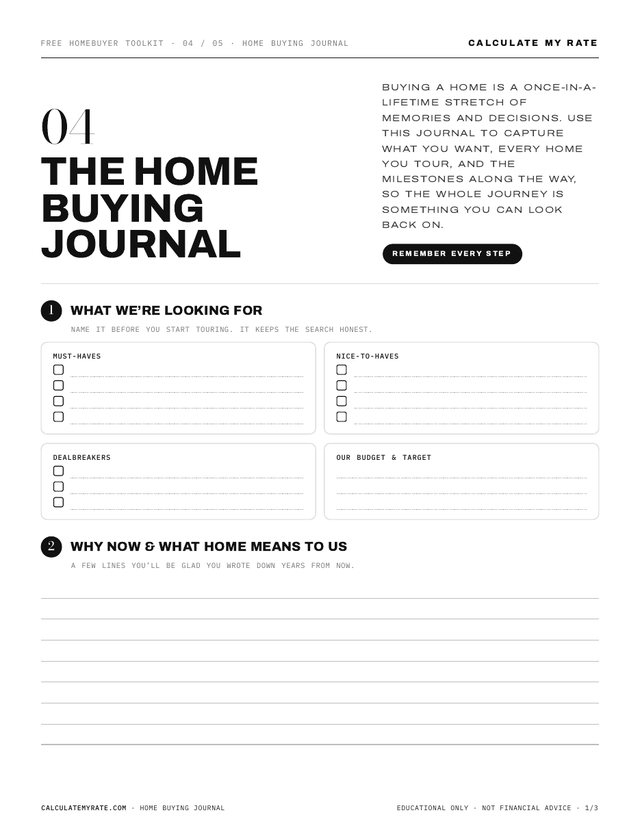
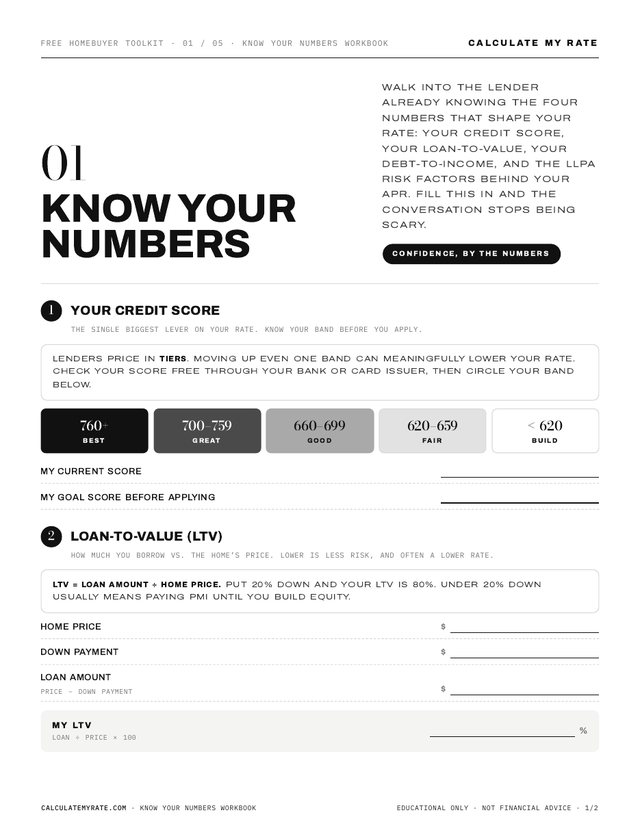
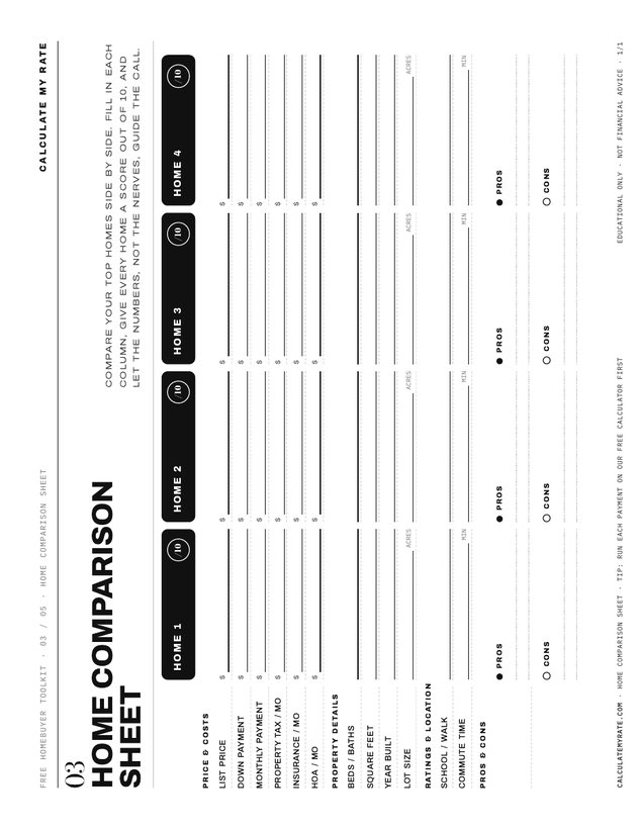
Five worksheets that take you from your first credit check to your first year in the home. Download, print, and fill them in by hand. No signup, no email.
One 10-page PDF · letter size · prints in black & white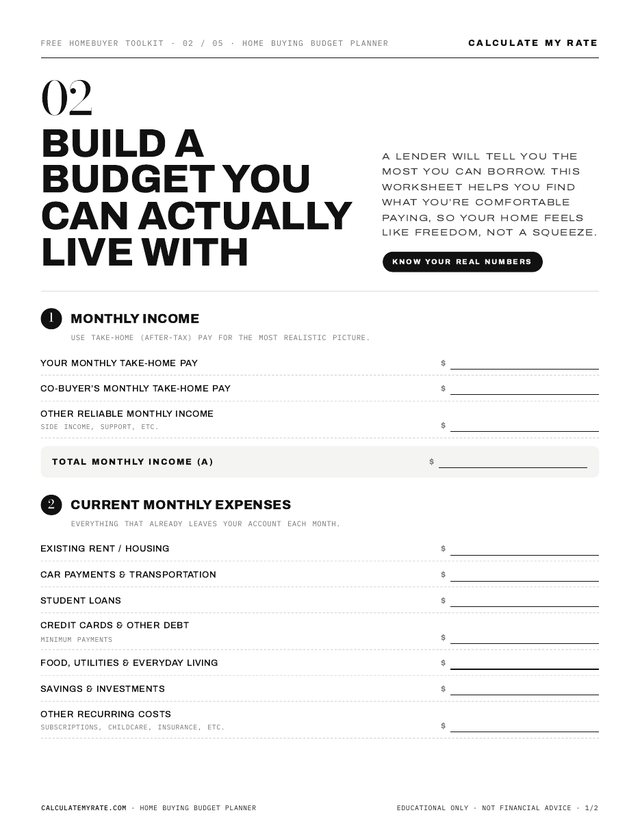

Pick your credit score, down payment, property and loan. We estimate the rate a lender would price for you, then build the full monthly payment and payoff schedule. Everything updates as you move.
Estimates for education, not a loan offer. Rate adjustments are a simplified model of how lenders price credit, down payment, occupancy and term; your real rate depends on your lender and the market on the day you lock. PMI is estimated for conventional loans under 20% down.
Early payments are mostly interest; the principal share grows over time.
Compares principal & interest on your current balance at both rates over the new term. Resetting the clock on a loan you've paid for years can raise total interest even when the payment drops.
PMI rates are market estimates by credit score and loan-to-value (roughly 0.5%–1.6% of the loan a year). A new appraisal after your home gains value can get you there sooner.
Modeled on Fannie Mae's published Loan-Level Price Adjustment matrix for purchase loans. Condo, 2–4 unit and non-primary add-ons are simplified. Lenders usually fold LLPAs into your rate at roughly 0.25% of rate per point.
See exactly how much of each payment goes to interest and how much pays down your loan, and what a little extra principal each month does to your payoff date.
Short, clear guides: your rights, the fees nobody explains, and how to make lenders compete for you. Read a few, then go run your numbers with confidence.
Three numbers every buyer should know before talking to a single lender.
After you apply, the lender owes you a free Loan Estimate within three business days. It's the law. Read one with us
Today's FICO models count every mortgage credit pull inside 45 days as one. Shop inside 14 days to be safe on every model. How it works
PMI must end automatically when your balance reaches 78% of the original value. You can ask at 80%. Find your month
Move your credit score and down payment and watch your rate update.
Clear definitions of common mortgage terms, so your Loan Estimate, your rate and the whole process finally make sense.
The Loan Estimate is a standard three-page form every lender must give you within three business days of applying. Same format from every lender, so you can compare them line for line.
The core numbers that define your loan.
What you’ll actually pay each month, now and later.
The two headline closing numbers.
What the lender charges to make the loan.
Third-party services the lender picks.
Services you’re allowed to price-shop yourself.
A + B + C — everything tied to getting the loan.
Charges from your local government.
Costs paid in advance at closing.
Seeds your escrow account.
Optional or situational items.
E + F + G + H.
D + I, minus lender credits.
How closing costs become the check you write.
Three numbers built for shopping lenders.
Rights, requirements and what-ifs.
Signing here is not a commitment.
Calculate My Rate is an independent educational platform that gives every home buyer the clarity, confidence and tools to navigate the mortgage process, without the pressure, the pitch or the confusion.
Going through the home-buying process can feel overwhelming. Between rate quotes, LLPA adjustments, closing cost breakdowns and Loan Estimates full of terms you've never heard, it's easy to feel like the whole system is designed for everyone but you.
We went through it ourselves. We sat across from lenders without knowing what questions to ask, signed documents we didn't fully understand, and wished there had been a place to go just to understand the numbers, without anyone trying to sell us something.
That's exactly what Calculate My Rate is. We built the tools we wished existed, and we made them free for everyone, because financial clarity shouldn't be a luxury.
"We built the tools we wished existed when we bought our homes. Educational, empowering tools to put you in the best spot possible, before you ever sit down with a lender."Calculate My Rate, LLC
No lender to sell, no affiliate fees to collect, no loan to pitch. Our only interest is yours.
Every number we show is explained. Every term is defined. We break complexity down so you can own it.
No lender to sell, no affiliate fees, no loan to pitch.
Calculators update live as you adjust, so you see exactly what moves your rate.
Every article, guide and glossary term is written to inform, never to impress or intimidate.
No signup. No sales calls. No follow-up emails. Use the tools on your own terms.
First home or fifth, no financial background required.
And when you're ready, start with the calculator. No signup, no pressure, just the math.
No. Everything on Calculate My Rate (the calculators, articles, glossary and guides) is for educational purposes only. We help you understand the numbers so you can ask better questions. Nothing here is a recommendation to buy, sell, borrow or invest. Always work with a licensed lender, financial advisor or real estate professional for advice specific to your situation.
The rates in our calculator are educational estimates based on publicly available LLPA data and general market conditions. They are not a quote, not a commitment to lend, and not guaranteed. Your actual rate depends on your full financial profile, the lender you choose, and the market when you lock. Always get a formal Loan Estimate from a licensed lender for your actual numbers.
No. We don't make loans or pitch you one. We're an independent educational platform with no mortgage product to sell and no lender relationship that influences what we show you. No pressure, no follow-up calls, no agenda.
A loan-level price adjustment (LLPA) is a risk-based fee Fannie Mae and Freddie Mac charge on most conventional mortgages. It's based on your credit score, down payment, property type and other factors, and it's folded into your interest rate instead of shown as a separate charge. Our LLPA adjuster shows you exactly which cell of the pricing grid you land in.
Absolutely. That's exactly who we built them for. You don't need a lender, a pre-approval, or even a specific home in mind. The tools work best before you talk to lenders, so you know what questions to ask and what numbers to expect.
That's expected. Our calculator gives you an educational estimate so you know the ballpark before you walk in. A lender's quote reflects your full credit file, the specific loan program, their own pricing and that day's market. Use our numbers to understand what drives your rate, then compare real Loan Estimates across lenders.
Calculate My Rate was built by people who went through the home-buying process and felt blindsided by how complicated, and how opaque, mortgage pricing really is. We built the tools we wished had existed. When buyers understand their numbers, they make better decisions and ask better questions.
Calculate My Rate, LLC is an independent educational platform. All content, calculators and estimates are for informational purposes only and do not constitute financial, legal or mortgage advice. Results are not a commitment to lend, a guarantee of rate or terms, or a formal Loan Estimate as defined under RESPA/TRID. Calculate My Rate is not affiliated with any lender, bank, real estate agency or government entity.
Send us a note and we'll get back to you by email. No sales calls, ever.
Or email contact@calculatemyrate.com