Understanding loan-level price adjustments
If two buyers get different rates on the same loan, an LLPA is often why. It's a risk-based fee on most conventional mortgages, and because it's folded into your rate instead of shown as a charge, most people never notice it's there.
LLPA stands for loan-level price adjustment. It's a risk-based fee that Fannie Mae and Freddie Mac, the two companies that buy most conventional mortgages, charge based on how risky your specific loan looks on paper. The riskier the loan, the bigger the fee.
Here's the part that trips people up: you rarely pay an LLPA as a separate line item. Your lender folds it into your interest rate. So a higher LLPA shows up as a slightly higher rate, which quietly raises every monthly payment for the life of the loan.
How it reaches your payment
- Risk raises your LLPA. A lower credit score, smaller down payment, or non-primary property each adds risk, and a bigger fee.
- The LLPA lifts your rate. Rather than charge it upfront, the lender prices it into your rate. A bigger LLPA means a higher rate.
- The rate sets your payment. Your monthly payment is the loan amortized at that rate. Even a quarter-point adds up over the term.
What drives your LLPA
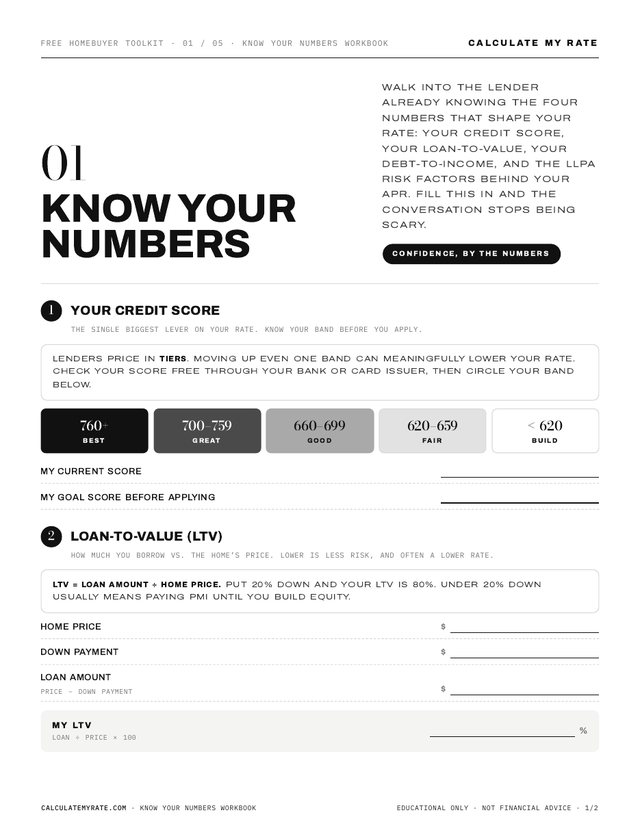
- Credit score: lower fee at 760+, higher as the score drops.
- Down payment: lower fee with more equity, higher with less.
- Occupancy: lowest for a primary home; higher for a second home or investment property.
- Property style: lowest for single-family; higher for condos and multi-unit.
- Loan purpose: lower for a purchase; higher for a cash-out refinance.
Why two people get different rates
Same house, same loan amount, same day. One buyer has a 780 score and 20% down; the other has a 690 score and 5% down. The second buyer's LLPA is larger, so their rate is higher. The loan is identical; the risk profile isn't.
How to lower yours
- Raise your credit score. Even crossing into the next tier can shrink the fee. Pay on time and lower card balances before applying.
- Put a little more down. Crossing certain equity thresholds reduces the adjustment. Ask your lender where the next break point is.
- Know the property counts. Investment properties and condos carry add-ons; budget for them from the start.
- Compare lenders. Fannie and Freddie set the LLPA, but how a lender prices it into your rate differs, so get more than one quote.
The bottom line
An LLPA isn't a scam or a hidden trap. It's how conventional loans price risk. The trick is knowing it exists, because the factors behind it are often the ones you can improve. Tighten your profile before you lock and you lower every payment for years.
Move your credit score and down payment and watch your rate update.